SELECTING PROPER GASKETS FOR WATER TREATMENT FACILITIES INVOLVES MANY CONSIDERATIONS
By Chett Norton, C.E.T
The importance of plant operators and operations in water treatment facilities selecting the right gaskets cannot be overstated. Unfortunately, they are often the last thing that anyone thinks about, and are in most cases considered a commodity item. However, most operators say that it is gaskets that can cause the most “pain” on a day-today basis. This means that selecting the right ones is important for process safety, environmental protection, service life, and maintenance and inventory costs.
The National Sanitation Foundation (NSF) has created standards that are intended directly for drinking water and systems that treat and deliver it. NSF/ ANSI 61 standard is based on the health effects of drinking water components.
Unfortunately, municipal facilities do not always use NSF 61 approved gasket material. Red rubber, styrene butadiene rubber (SBR), is continually used for potable water applications. But, it is not an ideal gasket material because it is a pure elastomer which naturally degrades over time, because of natural environmental conditions. Red rubber also has a very low compressive strength, generally in the range of 800 psi – 1200 psi, which can result in the material crushing if these values are exceeded.
In most flange pipe connections, the amount of torque applied to the bolting to achieve a minimum bolt stretch of 40% may exceed these values. Failing to stretch the flange bolts to this minimum yield can be problematic because the bolting material is not within its elastic region, and cannot create a “spring like” clamping effect on the flanges. This can result in a leak, or perhaps a blow-out failure.
The chemical resistance of SBR is relatively low against common water treatment chemicals like sodium hypochlorite, caustics, chloramine and others. These chemicals can aggressively attack the red rubber, resulting in a rapidly degraded or deteriorated gasket. When the gasket is chemically attacked, it is susceptible to leaks, failures or perhaps even a gasket blow-out which can seriously harm plant personnel if they are sprayed with these chemicals.
For general plant services that process non-potable water, steam and various forms of waste products, compressed non-asbestos (CNA) gasket material is a good choice because of its good sealing characteristics, ease of cutting and relatively low cost.
CNA gasket material has three main components: fibre (15% – 35%), binder (10% – 20%), filler (50% – 70%). Additionally, there is a small percentage of vulcanizing chemicals which are usually solvent based and used to cure the rubber based binders during manufacturing. Fibre is added to the CNA gasket material to provide increased mechanical properties like tensile and compression, and can include aramid, cellulose, ceramic and glass. The binder is usually composed of an elastomer, namely nitrile, styrene butadiene rubber, or even ethylene propylene diene monomer rubber, which keeps the sheet bound and gives the gasket material added flexibility.
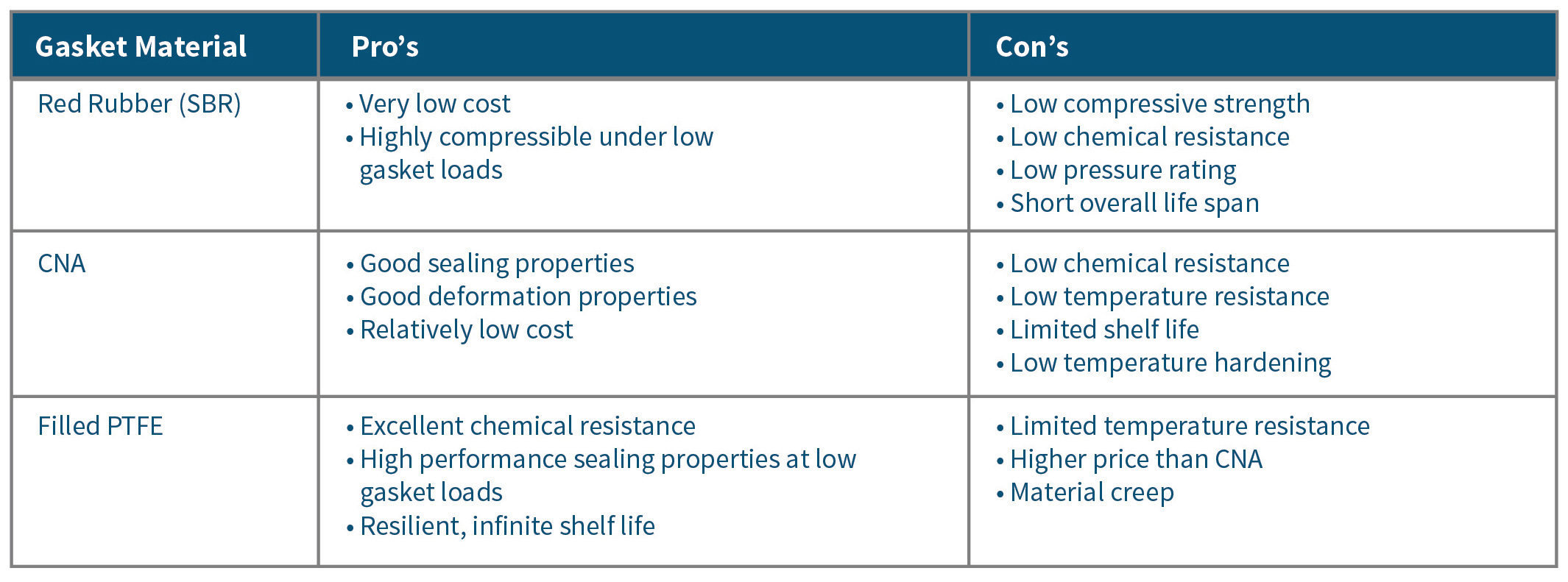
Fillers such as silica, mica, clay or even powdered graphite can be added to help control creep and reduce cold flow. Additionally, using fillers helps reduce the overall cost of the sheet because it consists of 50% – 70% of the total material. When selecting a CNA gasket material for potable water, the user should make sure they use a NSF 61 verified material to ensure that they are not contaminating the water source. Because CNA gasket material contains a rubber component, the material still does have a shelf life. Over time, the rubber will start to break down and deteriorate, based on exposure to environmental conditions.
Due to the rubber component of this type of gasket material, it is not recommended to seal applications that involve acids, or caustics which are used in pH control prior to the clarifying stages or even disinfection chemicals such as sodium hypochlorite (NaClO), 12% solution.
Even polymer-based chemicals used in wastewater treatment, including flocculants, coagulants and defoamers, can cause deterioration in rubber-based gasket materials. Therefore, it is very important to test the chemical resistance of the gasket material used with each chemical and to measure the concentration.
For critical service and chemical applications, filled polytetrafluoroethylene (PTFE) gasket material is an excellent choice because of its in-service longevity, chemical resistance and high sealability.
PTFE has an infinite shelf life; therefore, it does not break down during exposure to environmental conditions. This makes it a superior choice for applications that are not easily accessible or perhaps buried underground. PTFE is also inert to almost every chemical, making it a great choice for chemical applications.
Pure virgin PTFE has high creep/relaxation characteristics, so it is not a good sealing material. To help prevent material creep, gasket manufacturers use engineered filler systems that can consist of glass, barium sulfate and/or carbon.
Filled PTFE seals at a much lower gasket stress than compressed non-asbestos products. However, it can also withstand loads of up to 15,000 psi, which is more than 10 times the compressive strength of red rubber. 75 mm, 200 mm and 300 mm 150# ANSI flanges can be problematic to seal due to the low cross-sectional “bolt area” to gasket “sealing area” ratio. Full face gaskets are also difficult to seal when compared to ring gaskets, due to having two to three times more sealing area. For these applications, filled PTFE is a preferred sealing material.
Full face flanges are generally found on pumps and cast iron 125/250# piping. In many cases, you cannot generate enough gasket compression stress to create an effective seal without damaging the flanges. For these flat face flange applications, reducing the gasket area will help increase the gasket stress. When bolting up the gasket, a reduced contact area gasket made up of filled PTFE, will allow the full face skeleton design to support the entire flat face flange. It will also prevent any damage that may be caused by bending or flange rotation if a ring gasket were to be used.
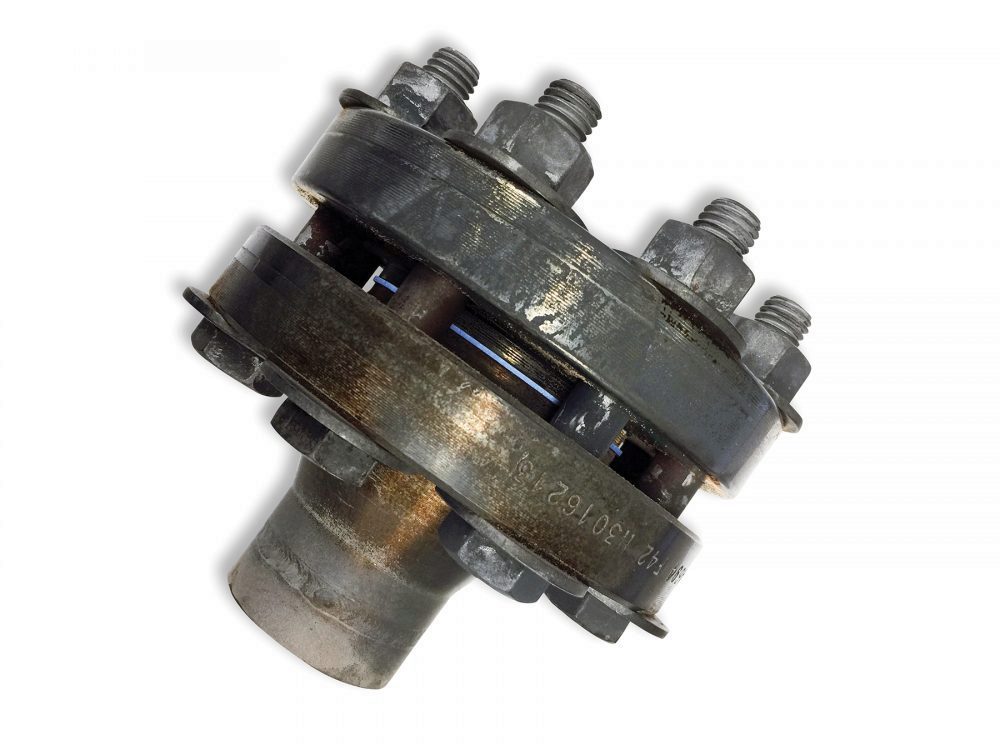
The application will influence the gasket selection; however, proper gasket installation is equally important. Based on 100 gaskets analyzed and material collected from the members of the Fluid Sealing Association, up to 85% of gasket failures were due to faulty user installation. Sixty-eight percent of the gaskets failed due to under compression, while 14% failed due to over compression.
It should be noted that both under and over compression of the gasket can be prevented if installers use a proper tightening method, recommended torque value and a calibrated torque wrench or other tightening device. For proper gasket installation methods, users can reference the ASME PCC-1 post construction guideline for pressure boundary bolted flange joint assembly. Gasket manufacturers provide recommended torque values and installation procedures.
Click here to view other articles from this issue (Dec 2017).
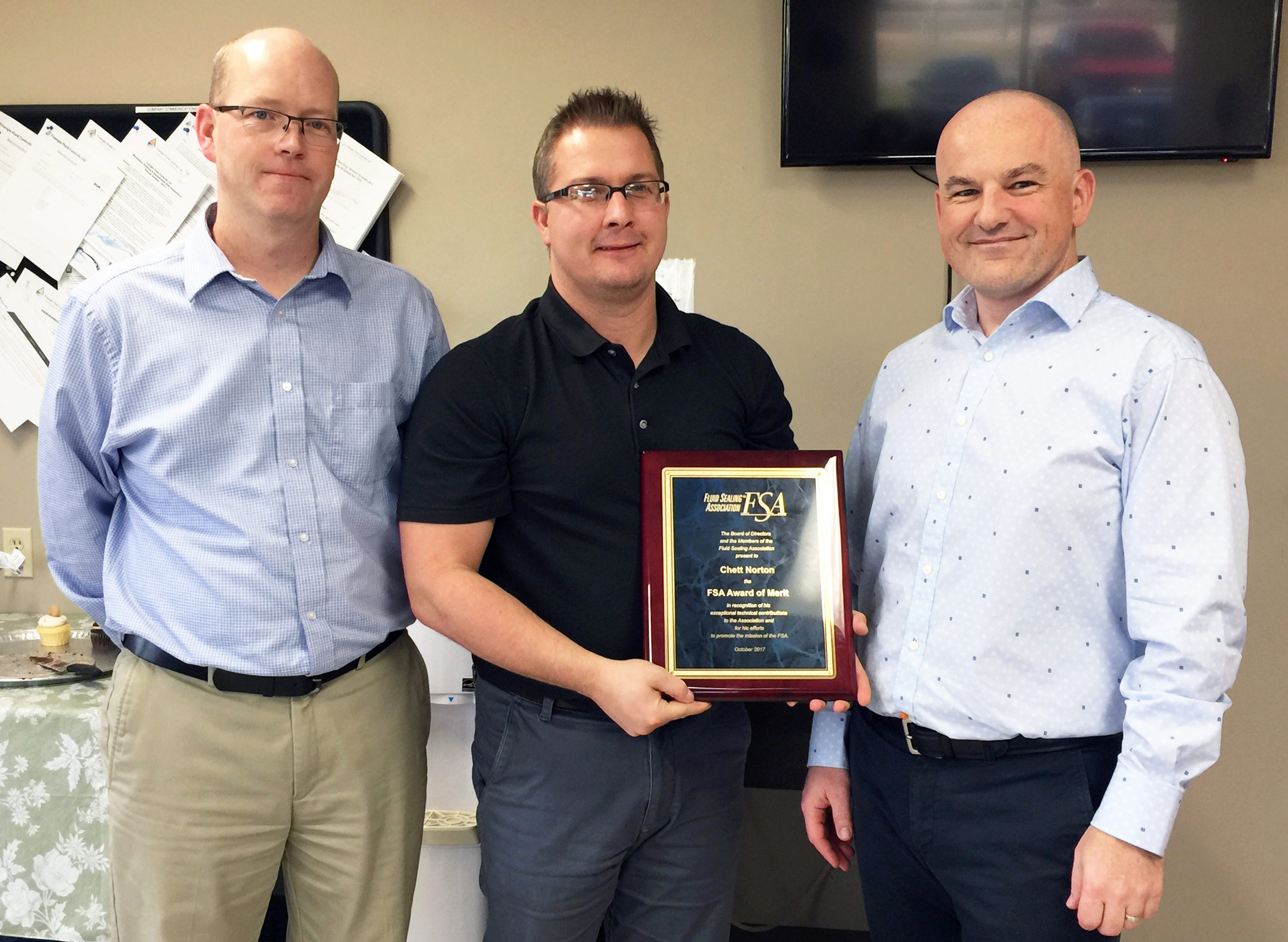
Triangle Fluid Controls (TFC) proudly congratulates Chett Norton as the recipient of the FSA Award of Merit in recognition of his exceptional technical contributions to the Association and for his efforts to promote the mission of the FSA.
The Award of Merit is presented by the Board of Directors and the Members of the Fluid Sealing Association and was established to recognize distinguished or exceptional service to the FSA by an individual member and granted solely on merit and participation in all activities that support the FSA mission.

Triangle Fluid Controls (TFC) is pleased to award the 2016 Randy McKay Sales Award of Merit to Yves Pariseau, in recognition for his outstanding sales performance with TFC. The award is given to TFC’s Regional Sales Manager (RSM) whose territory had the largest year-over-year sales increase from 2015 – 2016 and was presented August 24, 2017 at TFC’s headquarters in Belleville, Ontario. “We are extremely pleased to award Yves Pariseau with the Randy McKay Award of Merit,” said TFC’s General Manager, Mike Boyd. “Yves has been a valuable member of the TFC Sales team since 2006. During his tenure, Yves has done a great job developing his territory in Eastern Canada and we are excited at the prospect of future revenue growth in this region of Canada.”
The award, created in memory of the late Randy McKay, TFC’s Central Canada RSM, was created by TFC President Mike Shorts, as a means of paying homage to the former TFC employee. “Randy did a lot for TFC, was a stand-up individual, and somebody that I personally, learned a lot about sales from. After Randy’s passing in 2015, I knew I wanted to create an award in his memory.”
The award includes two pieces: an engraved glass plaque and hand-blown glass sculpture made in a similar shape, style, and colouring to TFC’s company logo. The glass plaque will hang in TFC’s lobby with each year’s winner added to it. The making of the pieces, commissioned by a local glass blower in Wellington, Prince Edward County, and was completely documented and can be found posted online on TFC’s social media channels or by clicking here.
Belleville, ON – March 3, 2017
Finding a reliable sealing solution has never been easier!
Triangle Fluid Controls (TFC) the manufacturer of Durlon sealing solutions is excited to present a brand new video series, SEALutions, that answers basic fluid sealing questions in 1-2 minute videos. Topics will range from gasket installation to reusing gaskets and troubleshooting joint leaks, among others.
SEALutions will star TFC’s Gasket Guru, a hands-on, tech guy with a plethora of fluid sealing knowledge to share. Starring as the Guru will be none other than TFC’s QA & Engineering Manager, Chett Norton. Chett has 14 years of experience in fluid sealing and industrial process and is a certified member with the Ontario Association of Certified Engineering Technicians and Technologists (Mechanical Discipline) as well as an active participating member of the Fluid Sealing Association’s Gasket Technical Committee.
TFC has released a teaser video that can be viewed below. Stay up to date with SEALutions by subscribing on YouTube. In the meantime, you can reach the Guru by e-mailing chett@trianglefluid.com for your fluid sealing needs.
March 1, 2017
Triangle Fluid Controls Ltd. (TFC) is proud to announce its debut as an associate member into the Chemistry Industry Association of Canada (CIAC) – the voice of Canada’s chemistry industry. CIAC represents Canada’s leading chemistry companies including petrochemical, inorganic and specialty chemical producers, bio-based manufacturers, and chemical transportation. CIAC members are recognized as world leaders in the sustainable stewardship of chemical products.
“Triangle Fluid Controls is happy to be working with CIAC members in sharing our unique knowledge of global chemical industry fluid sealing best practices to improve safety and reduce leaks and fugitive emissions in process piping and containment applications,” says Mike Shorts, TFC President.
TFC has many years of process safety know-how from manufacturing sealing devices for the world’s chemical, petrochemical, food & beverage, pharmaceutical, rail and manufacturing industries. TFC recognizes the importance of CIAC’s Responsible Care® program in helping to reduce health, safety and process safety incidents and looks forward to working with CIAC.
TFC will also be participating in Chemistry 2017 – CIAC’s two-day conference and trade show held in Toronto, Ontario, April 2017.
Durlon ® Sealing Solutions manufactured by Triangle Fluid Controls Ltd. is featured in the inaugural edition of the Fugitive Emissions Journal, December 2016.

Triangle Fluid Controls Ltd. (TFC) is delighted to announce that they have donated a newly created holiday addition to the City of Belleville’s annual Christmas Lighting Display. Along with a Santa-level sponsorship, a team of TFC elves worked diligently through the summer months to come up with a festive light display to share with thousands of local residents.
The annual lighting launch officially kicked off the holiday season on Friday, November 18th beginning at 5:45 PM at Jane Forrester Park in Belleville’s South-East end (near the city’s pier), and will remain lit through to the New Year.For a number of years, TFC has been happy to spread Christmas cheer throughout hometown Belleville, Ontario, by sponsoring the much-loved holiday creation that delights the young and young-at-heart and has become a beloved community tradition. The Christmas Lighting Display, originating from tragic events over 50 years ago, was built by a grieving family and epitomizes the true meaning of Christmas. Now operated by the City of Belleville, it is visited annually by thousands.
Be sure to check out Belleville’s must-see Christmas Lighting Display at Jane Forrester Park from November 18 – mid January. For more information visit: https://www.belleville.ca/recreation/page/christmas-lighting-display
Belleville, Ontario – September 29, 2016
 Triangle Fluid Controls Ltd. (TFC) the manufacturer of Durlon® sealing products, is proud to announce that the sanitary “white” version of its flagship product, Durlon® 9000N, has been successfully tested and certified to USP Class VI standards for use in the in the pharmaceutical and biotechnology industries. USP (short for United States Pharmacopeia) Class VI is a series of biological tests, requiring a product to show minimal to zero levels of toxicity, making it a suitable gasket material for use in medical devices and other applications where a ‘hygienic’ material is required.
Like the rest of Durlon’s PTFE material, Durlon® 9000N is FDA compliant, making it suitable for use in the pharmaceutical, chemical, food and beverage, and biotechnology industries. Offering USP certification among the Durlon® line of products, allows TFC to better meet the unique needs of its customers who span across a wide range of industries. For more information about Durlon® 9000N, please contact Triangle Fluid Controls Ltd.® at 1-866-537-1133, or info@trianglefluid.com.
Technical Documentation: Durlon® 9000N
Congratulations to Damon Wright, who has been promoted as TFC’s newly established Manufacturing Manager, announced August 17th, 2016. The former Warehouse Technician joined the company in 2013, and quickly proved himself an asset to the global gasket manufacturer. “Damon has accepted any and all challenges thrown his way and has excelled at completing them. He’s a key contributor to TFC’s team and is greatly respected among our staff,” says Mike Boyd, TFC Plant Manager, who will in October transition to General Manager of TFC. Damon’s new responsibilities will include overseeing and controlling all aspects of plant production operations including costs, efficiencies, hiring, and improving on processes and procedures in order to meet organizational goals and consumer demand.
The restructuring of TFC’s management comes as a result of a number of internal managerial promotions within TFC and across its’ privately held sister companies. TFC is currently recruiting for a Warehouse Technician at its Belleville, Ontario plant. A full listing for the position can be found here, or by e-mailing dan@trianglefluid.com.

Belleville, Ontario – July 28, 2016

Triangle Fluid Controls (TFC) is pleased to award the 2016 Randy McKay Sales Award of Merit to Ryan Kelly, in recognition for his outstanding sales performance with TFC. The award was given to TFC’s Regional Sales Manager (RSM) whose territory had the largest year-over-year sales increase from 2015 – 2016 and was presented July 28 at TFC’s headquarters in Belleville, Ontario. “We are extremely pleased to award Ryan Kelly with the first ever Randy McKay Award of Merit,” said TFC’s President, Mike Shorts. “Over his short time with us, Ryan has showed immense passion and dedication to our team that has not only seen revenue growth in new markets for TFC but would make the award’s namesake proud.”
The award, created in memory of the late Randy McKay, TFC’s Central Canada RSM, was created by Shorts as a means of paying homage to his former employee. “Randy did a lot for TFC, was a stand-up individual, and somebody that I personally, learned a lot about sales from. After Randy’s passing in 2015, I knew I wanted to create an award in his memory and present it to his family.”
Also in attendance at the award ceremony, was Randy’s son Brock, representing the McKay family. Brock was also awarded a glass sculpture on behalf of TFC, for his father’s dedication to the company. “This place [TFC] meant a lot to him. It was inspiring to see someone who had such a passion for what they did,” remembered Brock.
The award included two pieces: an engraved glass plaque and hand blown glass sculpture made similar in shape, style, and colouring to TFC’s company logo. A second plaque will hang in TFC’s lobby with each year’s winner added to it. The making of the pieces, commissioned by a local glass blower in Prince Edward County, was completely documented and can be found posted online on TFC’s social media channels or by clicking here.